Counting and Numbers
Hook
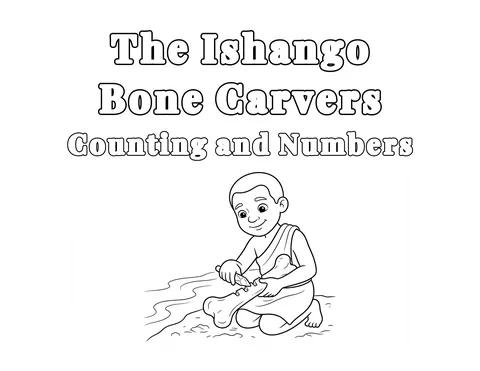
Imagine you are living twenty thousand years ago, somewhere near a lake in what is now the Democratic Republic of Congo. There are no schools, no pencils, no paper. But you have a problem: you need to remember something. Maybe you want to track how many fish you caught, or how many days until the full moon returns. What do you do? You pick up a bone — the fibula of a baboon — and you scratch marks into it. One mark for each fish. One mark for each day. You have just invented counting.
Core Concept
Counting is the first mathematical act in human history. At its heart, it is the idea that we can assign a number — an abstract symbol — to a collection of real things. Three fish, five days, twelve stars. The number and the thing are separate: the number three does not smell like fish or shine like a star. That separation — between a quantity and the things being counted — is one of the most powerful ideas our species has ever had.
Numbers grew in complexity over time. First came the natural numbers: 1, 2, 3, 4... the counting numbers we teach children. Then came the discovery that you can do things with numbers: add them, subtract them, multiply them, divide them. Then came a startling question that would take thousands of years to answer: what happens when you subtract a number from itself? What is 3 minus 3? What is nothing? That question led to one of the greatest mathematical inventions of all time — but we will save that for Document 4.
The story of numbers is also the story of notation: how do you write them down? The Romans used letters (I, V, X, L, C, D, M). The ancient Egyptians used different symbols for ones, tens, hundreds. The Babylonians used a clever base-60 system — we still feel its echoes today every time we divide an hour into 60 minutes or a circle into 360 degrees. The system most of the world uses today — the one where 10 is written as 10 and not as X — came from India, and its development was one of the most consequential events in intellectual history.
Everyday Examples
Every time you count your toys, you are using the same basic idea as the Ishango bone carvers. Every time you look at a clock and see the number 4, or read a house number on a street, or see the score in a football match — you are reading a number. Numbers are so embedded in our world that it is almost impossible to imagine life without them. Try this: describe your street without using any numbers. No distances, no building numbers, no floor levels, no bus routes. You cannot do it. That is how fundamental numbers are.
Foundational Discovery or Proof
The Ishango bone, discovered in 1950 near Lake Edward in central Africa, is one of the oldest known mathematical objects in the world. It dates to between 18,000 and 20,000 BCE. It has three columns of notches, carefully grouped in patterns. Some researchers believe the groupings represent a primitive lunar calendar. Others think they show early arithmetic — even the beginnings of multiplication. We cannot be certain, because its creators left no written explanation. But the care and intentionality of the marks are unmistakeable. Someone was thinking mathematically, twenty thousand years ago, before any known civilisation, before writing, before cities.
Thousands of years later, the Indian mathematician Brahmagupta (598–668 CE) took a different kind of revolutionary step. He was the first mathematician to systematically define the rules for arithmetic — not just counting, but the operations we apply to numbers. In his masterwork, the Brahmasphutasiddhanta (628 CE), he wrote down the rules for addition, subtraction, multiplication, and division of both positive and negative numbers. More radically, he defined the number zero as the result of subtracting a number from itself — and worked out what happens when you add, subtract, and multiply with it. He even attempted to divide by zero, a problem so thorny it would not be fully resolved for over a thousand years.
The Scientist(s) Behind It
The Ishango bone carvers are anonymous to us — we know nothing of their names, their faces, or their lives. But their small act of scratching marks into bone echoes across twenty millennia. They remind us that the mathematical impulse — the need to count, to track, to record — is not a modern invention. It is part of what it means to be human.
Brahmagupta was born in 598 CE in Bhinmal, in what is now the Indian state of Rajasthan. He was the director of the astronomical observatory at Ujjain, one of the great centers of learning in the ancient world. His work was not just theoretical: he needed accurate mathematics to calculate the positions of planets and predict eclipses. Mathematics, for Brahmagupta, was a tool for understanding the cosmos. He wrote his great treatise in verse — in Sanskrit poetry — because in his culture, important knowledge was composed in forms that could be memorised and recited. Imagine learning your multiplication tables as a poem.
Connection to Your World
When you count your building bricks or figure out how many days until your birthday, you are following a thread that stretches all the way back to those anonymous bone carvers by an African lake. And when you learn addition and subtraction — the rules that Brahmagupta wrote down in the 7th century — you are studying ideas that were considered revolutionary discoveries, not obvious facts. The number system you use every day — the one where you write 7, 23, 100 — is an Indian invention that spread across the world because it was simply better than everything else. The next time you write the number 0, think of Brahmagupta. He gave you that.
Wonder Question
The Ishango bone is twenty thousand years old. Writing was invented only about five thousand years ago. That means humans were doing mathematics for fifteen thousand years before they could write it down. What were they thinking about? What did they count? And here is a stranger question: are there other animals that count? Bees can distinguish between three flowers and four flowers. Crows can count up to five. Dolphins recognize quantities. If counting feels like the most human of activities — what does it mean that it is not only ours?