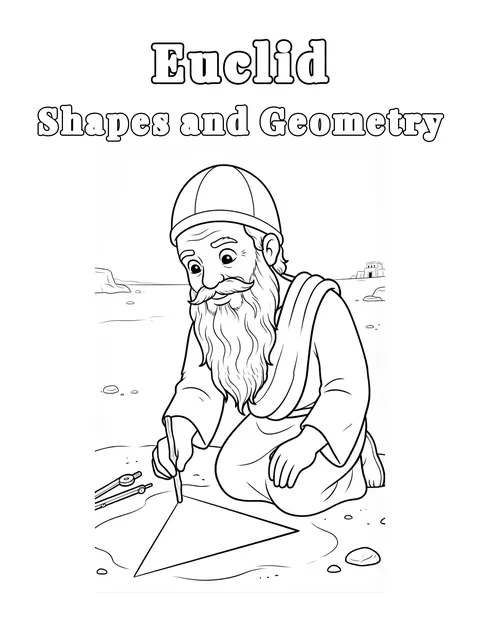
Shapes and Geometry
Hook
Take a blank piece of paper. Draw a dot. Draw another dot. Now draw a straight line connecting them. You have just done something that sounds trivially simple — but which contains a deep mystery. That line is perfectly straight, with no width at all, stretching forever in both directions. Can you actually draw that? No. Your pencil has width. Your paper has edges. In reality, a true geometric line does not exist in the physical world. It lives only in the mind. And yet — using this invisible, impossible line — mathematicians have built structures so precise that they govern architecture, astronomy, engineering, and physics to this day. Welcome to geometry.
Core Concept
Geometry is the mathematics of shapes, space, and their relationships. The word itself comes from the ancient Greek: geo (earth) and metron (measurement). The Egyptians and Babylonians used geometry practically — to survey land after the Nile floods, to build temples, to calculate the area of fields. But around 300 BCE, a Greek mathematician named Euclid did something extraordinary: he asked not just how to use geometry, but why it works. He wanted to build all of geometry from the ground up, starting from a handful of simple truths that no one could argue with, and deriving everything else from those truths by pure logic.
His method was to start with definitions (what is a point? a line? a circle?), then postulates (simple rules assumed to be true), and then use these to prove theorems — statements that must be true because the logic is airtight. This approach — start with simple assumptions, derive everything by careful reasoning — became the model for all of mathematics, and much of science, for over two thousand years.
The shapes you know and love — triangles, squares, circles, hexagons — all have precise geometric properties that Euclid studied. A triangle's three angles always add up to 180 degrees. The area of a circle is pi times the radius squared. A square has four equal sides and four right angles. These are not random coincidences. They are theorems — things that can be proven from first principles.
Everyday Examples
Geometry is everywhere once you start looking. Buildings are made of geometric shapes — rectangles, triangles, arches — because these forms have structural properties that make them strong. A triangle, for instance, cannot be distorted without changing the length of its sides, which is why triangles appear in bridges and roof trusses. The wheels of every vehicle are circles — the most efficient shape for rolling — because a circle maintains a constant distance (the radius) from its center to its edge. Honeybees build hexagonal honeycombs because hexagons tile a flat surface perfectly with no wasted space. Soccer balls are made from pentagons and hexagons — a geometric pattern called a truncated icosahedron. Even your lungs have a geometry: their branching structure is designed to maximise surface area in a small volume.
Foundational Discovery or Proof
Euclid's masterwork, the Elements, written around 300 BCE in Alexandria (in what is now Egypt), is one of the most influential books ever written. It is a systematic presentation of geometry and number theory in 13 volumes, building from 5 postulates to 465 propositions. The fifth postulate — the parallel postulate — states that through any point not on a given line, there is exactly one line parallel to the given line. This postulate troubled mathematicians for two millennia because it seemed less obvious than the others. In the 19th century, mathematicians discovered that you could build entirely consistent geometries by replacing this postulate — geometries where parallel lines eventually meet, or where triangles have angles that don't add up to 180 degrees. These non-Euclidean geometries turned out to be essential for Einstein's theory of general relativity, where space itself is curved.
But the most famous result in all of Euclid — perhaps in all of mathematics — is the Pythagorean theorem. In a right-angled triangle, the square of the longest side (the hypotenuse) equals the sum of the squares of the other two sides: a squared plus b squared equals c squared. This result was known before Euclid — Babylonian tablets show it was used 1,500 years earlier — but Euclid gave it the rigorous proof that made it immortal.
The Scientist(s) Behind It
Almost nothing is known about Euclid the man. We do not know his birth date, his death date, or even where he was from. We know he worked in Alexandria during the reign of Ptolemy I (around 300 BCE), and we have a single anecdote: Ptolemy himself, studying the Elements, asked Euclid if there was a shorter path to geometry than working through all the proofs. Euclid replied: "There is no royal road to geometry." The work had to be done. The understanding had to be earned.
This tells us something important about Euclid's philosophy of mathematics: there are no shortcuts. No amount of rank or wealth can let you skip the reasoning. Every person who wants to understand geometry must follow the same logical path. That democratic spirit — mathematics as something available to anyone willing to do the thinking — is one of the great gifts of the Greek tradition.
Connection to Your World
Every shape you draw and every building you look at exists inside the world Euclid described. When you notice that your bedroom door is a rectangle, or that a pizza is a circle, or that a tent is a triangle — you are seeing Euclidean geometry. When you play with blocks and discover that some shapes stack well and others don't, you are doing the same thing architects and engineers do: figuring out which shapes work best for which purposes. And here is something to try: draw a triangle, any triangle, and carefully measure its three angles with a protractor. Add them up. You will always get 180 degrees. Not approximately. Not usually. Always. That is what a theorem means — a truth that holds forever, for every triangle in existence.
Wonder Question
Euclid built his entire geometry on five postulates — five simple rules he assumed to be true. But what if they weren't? What if space itself weren't flat, but curved, like the surface of a sphere? On a sphere, the angles of a triangle add up to more than 180 degrees. Two lines that start out parallel will eventually meet at the poles. This "spherical geometry" isn't just a thought experiment — it is the geometry of the surface of the Earth. Pilots and ship navigators use it every day. And Einstein discovered that gravity is actually the curvature of spacetime — a geometry that Euclid could not have imagined. Does it unsettle you that geometry depends on where you are — that different universes could have different geometries? What shape do you think our universe really is?