The Invisible World in a Drop of Water
Hook
Picture a single drop of water from a pond near your house. Now imagine someone tells you that drop isn't empty at all — that it's actually crowded, packed with thousands of tiny living things swimming around, wriggling, and going about their business, all completely invisible to your eyes. That would sound like magic. In the late 1600s, one man looked through a homemade lens and discovered it was simply true.
Core Concept
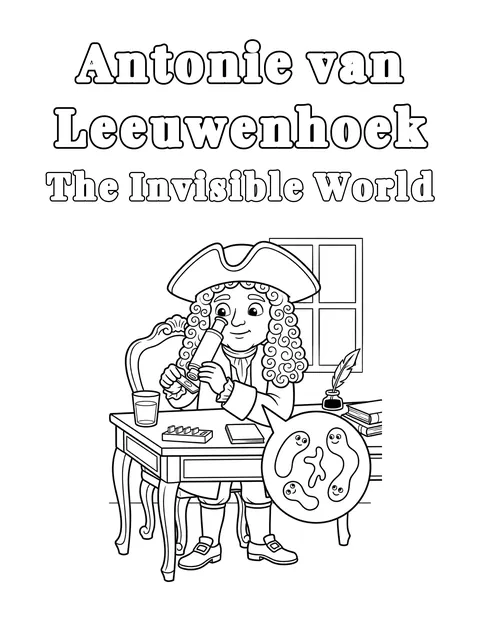
His name was Antonie van Leeuwenhoek (pronounced LAY-ven-hook), and he wasn't a scientist by training at all. He ran a cloth shop in the Dutch city of Delft. Cloth merchants of the time used small magnifying lenses to count the threads in fabric and check its quality — and Leeuwenhoek became obsessed with making his lenses better than anyone else's. He taught himself to grind and polish tiny glass lenses by hand, over and over, refining his technique purely out of curiosity about how good he could actually get. Historians estimate his lenses could magnify somewhere between 200 and 500 times, with roughly 270 times being the figure most often cited — an extraordinary level of detail for the era, achieved by someone with no formal scientific training at all.
Everyday Examples
Leeuwenhoek pointed his lenses at everything he could find: rainwater, pepper infused in water, scrapings from between his own teeth, and pond water. What he saw shocked him. Inside that ordinary pond water were tiny creatures — moving, distinct, alive — that no human eye had ever seen before. He called them "animalcules," meaning "little animals." He'd stumbled onto an entire scale of life that had been sitting right in front of everyone, always, invisible only because nobody had ever built a lens good enough to reveal it.
Foundational Method
Leeuwenhoek first mentioned unusual observations in letters as early as 1676, but it was in 1683 that he sent his most famous and thoroughly documented account to the Royal Society in London — complete with careful illustrations of the tiny organisms he'd found, including what we now recognize as bacteria from his own teeth scrapings. That 1683 letter, with its drawings, is the moment most historians point to as the clear, well-documented birth of a discovery that would eventually become the field of microbiology — the scientific study of living things too small to see without help.
Scientist Portrait
Here's what's remarkable about Leeuwenhoek's method: he had no scientific training, no university position, and no institution behind him. He had patience, curiosity, and an almost stubborn dedication to making his lenses just a little bit better, over and over, for years. When he finally wrote to the Royal Society describing what he'd seen, some scientists there were skeptical — it seemed too strange to be true. They eventually sent someone to Delft to check his work in person, and confirmed that what he described was real.
Leeuwenhoek's example is a genuinely unusual one in the history of science. Most of the people in this series had formal training, university positions, or institutional support behind them. Leeuwenhoek had a cloth shop and a workbench. He ground over 500 lenses over the course of his life, most of which he kept private, and he never fully explained his exact lens-making technique to anyone — some of his methods likely died with him. He simply kept looking closer at ordinary things until he found something nobody had ever seen.
Once the Royal Society confirmed his observations, Leeuwenhoek kept going. Over the following decades, he sent them letter after letter, describing new observations from blood, muscle fibers, insect anatomy, and more pond water — dozens of letters in total, spanning roughly fifty years, right up until close to his death at 90 years old. The Royal Society eventually made him a full member, an unusual honor for a tradesman with no university degree, awarded purely because his careful, patient observations kept turning out to be correct.
Connection to Your World
You don't need a 17th-century handmade lens to follow in Leeuwenhoek's footsteps. A basic magnifying glass or even a cheap plastic microscope can reveal detail in a leaf, a grain of salt, or a strand of hair that's invisible to the naked eye. The next time you're near a puddle, a pond, or even just a glass of water left out for a few days, remember: Leeuwenhoek's entire discovery started with someone willing to look closely at something everyone else assumed was just plain water.
Wonder Question
Leeuwenhoek spent his life looking at a world that was already there, waiting to be noticed by anyone patient enough to build the right tool and look closely enough. Scientists today use microscopes far more powerful than anything Leeuwenhoek could have imagined, and they're still finding living things — in soil, in deep ocean water, even inside our own bodies — that nobody knew existed.
So here's something worth wondering about: if an entire invisible world of life was hiding in a single drop of pond water the whole time, just waiting for someone to look closely enough — what other worlds might be hiding in ordinary things around you right now, invisible only because nobody has looked closely enough yet?