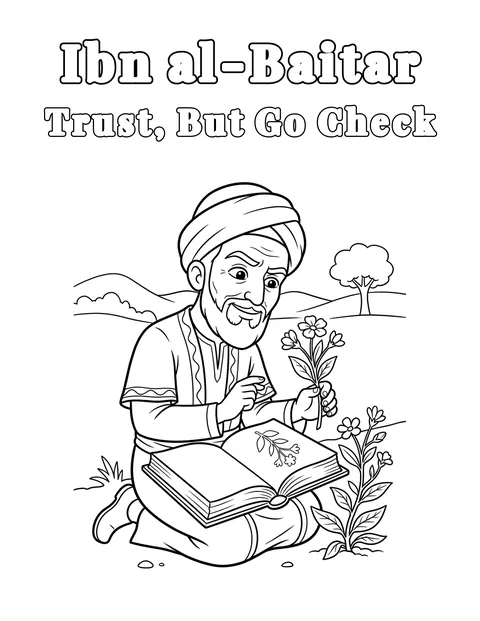
Trust, But Go Check: The Traveling Scholar Who Tested Everything
Hook
Imagine you found an old book that told you a certain plant could heal a wound — but you'd never actually seen anyone try it, and the book was already hundreds of years old by the time it reached you. Would you trust it completely? Or would you want to go find that plant yourself, test it, and see what actually happens?
Nearly 800 years ago, one scholar chose the second option, and he didn't just do it once — he spent his entire life doing it, plant by plant, across thousands of miles.
Core Concept
His name was Ibn al-Baitar (pronounced ib-uhn al-by-TAR), born around 1197 in Málaga, in what is now southern Spain, then part of the Islamic world known as al-Andalus. At the time, doctors and scholars relied heavily on medical texts written centuries earlier by ancient Greek and Roman writers — books that had been copied, translated, and passed down for so long that errors, guesses, and outdated information had crept in everywhere. A plant might be described in a way that no longer matched reality, or a Greek writer might have simply gotten something wrong a thousand years earlier, and that mistake would just keep getting copied forward, generation after generation, as if it were settled fact.
Ibn al-Baitar's core idea was radical for his time: instead of trusting what the old books said, go find the actual plant, in the actual place it grows, and test it yourself.
Foundational Method
So that's exactly what he did. Starting as a young man, Ibn al-Baitar spent decades traveling across North Africa and the Islamic world — through what is now Spain, Morocco, Algeria, Tunisia, Libya, Egypt, and into Arabia and the Levant — collecting, examining, and testing plants and other natural substances used in medicine. He didn't just gather specimens; he cross-checked what he found against what the old texts claimed, and when reality didn't match the books, he corrected the record. Over the course of his career, historians estimate he named and corrected roughly 150 earlier Arabic medical authorities and around 20 ancient Greek ones by name — pointing out, specifically, where each had gotten something wrong.
His life's work came together in a massive reference book called the Kitab al-Jami, or the "Comprehensive Book of Simple Drugs and Foods" — a catalog of roughly 1,400 different medicinal substances, described plant by plant, mineral by mineral, with notes on their uses, their sources, and how earlier writers had described them (correctly or not). Of those 1,400, several hundred were substances Ibn al-Baitar was among the first to describe in this kind of careful, tested detail — a genuinely enormous contribution to medical knowledge for one person's working life, especially one built on direct fieldwork rather than borrowed authority.
Scientist Portrait
What made Ibn al-Baitar unusual wasn't just his output — it was his method. He treated old authorities with respect, but not with blind trust. If a famous Greek physician from a thousand years earlier had written something about a plant, Ibn al-Baitar would go find that plant, in its natural habitat, and check. Sometimes the old description held up. Sometimes it didn't, and he said so, by name, in his own writing. That combination — respect for accumulated knowledge, paired with a refusal to accept it without testing — is close to the core of what we now call the scientific method, even though the phrase itself wouldn't be used for centuries.
Ibn al-Baitar eventually settled in Cairo, working as chief herbalist for the sultan, but fieldwork remained central to how he worked throughout his life. He wasn't content to sit in a library surrounded by old manuscripts, even once he'd earned a position that would have let him. He kept going out, kept looking, kept testing.
The Kitab al-Jami didn't stop mattering after Ibn al-Baitar's death in 1248. It went on to become a standard medical and pharmacological reference across the Islamic world for centuries, and was later translated and studied in Europe as well, where physicians and pharmacists continued consulting it long after his lifetime. A catalog built almost entirely on one person's direct fieldwork ended up shaping how multiple civilizations understood medicinal plants for generations afterward.
Connection to Your World
You can borrow a small piece of Ibn al-Baitar's method any time you hear a claim about the natural world — in a book, online, or from a friend. Instead of just accepting it, ask: has anyone actually checked this? Could I go look for myself? Even something simple, like noticing whether a plant in your own neighborhood really does attract the insects a book says it does, is a tiny echo of exactly what Ibn al-Baitar spent his whole life doing on a much larger scale.
Wonder Question
Ibn al-Baitar corrected dozens of respected authorities across two entire scholarly traditions — not because he set out to prove anyone wrong, but because he was willing to go check. That raises an interesting question about knowledge itself: if some of the most trusted medical writers in history could still get things wrong when nobody double-checked them for centuries, what ideas do you think people accept as true today simply because nobody has gone back to test them recently?