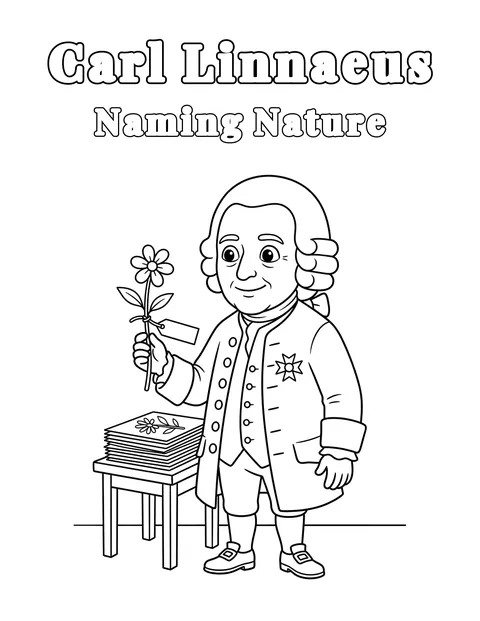
Naming Nature: How the World Agreed on What to Call Things
Hook
Imagine you saw a small brown bird in your backyard and told a friend about it. Now imagine that same bird flew all the way to another country. Someone there saw it too — but they called it something completely different, in a completely different language. If those two people tried to compare notes, they'd have no idea they were even talking about the same animal. For most of human history, that confusion was just how nature worked. Every region, every language, sometimes every village, had its own names for the same plants and animals. Scientists trying to study nature together were, in a very real sense, unable to understand each other.
Core Concept
One man decided this was a problem worth solving — not by discovering a new species, but by inventing a way for everyone in the world to agree on what to call the ones we already knew.
His name was Carl Linnaeus (pronounced lih-NEE-us), a Swedish botanist born in 1707. Linnaeus is often remembered as the person who "invented" the naming of living things, but that's not quite accurate, and getting it right matters. Two-part naming already existed here and there before him, used unevenly by a handful of earlier botanists. What Linnaeus actually did was something harder: he took a messy, inconsistent idea and turned it into a single, universal system — one that could be applied, the same way, to every living thing on Earth. He systematized it. He popularized it. And he made it stick.
Everyday Examples
Here's the system in plain terms: every species gets exactly two names, always in Latin, always written the same way. The first name is the genus — a bigger group of closely related living things. The second is the species — the specific one within that group. Together, they form a name that means the same thing no matter what language you speak. A scientist in Brazil and a scientist in Japan can both say Panthera leo and know, instantly, that they're both talking about lions. Your dog has a two-part name too: Canis familiaris. So do you: Homo sapiens.
Foundational Method
Linnaeus didn't just come up with this idea — he used it. In 1758, he published the tenth edition of a book called Systema Naturae ("The System of Nature"), and it was enormous in scope. Working mostly from specimens, sketches, and reports sent to him from around the world, he sorted roughly 4,400 animal species and about 7,700 plant species into a nested set of categories — kingdom, class, order, genus, species — based on shared physical traits. It was less like writing a book and more like building a filing cabinet the size of the entire natural world, with a drawer for everything anyone had found so far.
Scientist Portrait
To fill those drawers, Linnaeus needed specimens from everywhere — and he couldn't travel everywhere himself. So he trained a group of students, sent them out on ships to distant parts of the world, and asked them to collect, describe, and send specimens home. He was proud enough of this project that he nicknamed these students his "apostles." Some of their journeys were genuinely dangerous — long ocean voyages to unfamiliar places, in an era with none of the safety nets we have today — and a few of Linnaeus's students never made it home. The ones who did return, though, filled in huge parts of the natural world that Linnaeus himself never got to see with his own eyes.
Linnaeus was also, by most accounts, a man who liked things ordered and enjoyed being clever about it. He gave himself a more scholarly-sounding Latin version of his own name — Carolus Linnaeus — for his scientific work. And when a fellow botanist named Johann Siegesbeck publicly criticized Linnaeus's classification system, Linnaeus responded by naming an unpleasant, sprawling weed Sigesbeckia in his honor. It's a small, very human detail buried inside an otherwise very tidy system: even the person organizing all of nature couldn't resist a little mischief.
Connection to Your World
You've almost certainly already run into Linnaeus's system without realizing it. Any time you see an animal or plant's scientific name — always two words, always italicized, like Tyrannosaurus rex or Ursus arctos — you're looking at something built on the exact structure Linnaeus set up more than 250 years ago. Try it yourself: look up the scientific name of your favorite animal, or even your own pet. You'll find a two-part Latin name doing the same job Linnaeus designed it to do — letting anyone, anywhere, know exactly what living thing you mean.
Wonder Question
But Linnaeus's system wasn't the end of the story — it was a starting point. He organized life based on what he and his era could observe and understand in the 1700s. Since then, scientists have kept discovering new species, and they've also gone back and reorganized some of Linnaeus's original groupings as they learned more about how living things are actually related to each other, sometimes using tools like DNA that didn't exist in his lifetime.
So here's a question worth sitting with: if scientists are still finding new species today, and still occasionally regrouping ones we already know as we learn more about them — what do you think future scientists might discover, split apart, or connect together that we haven't even imagined yet?